

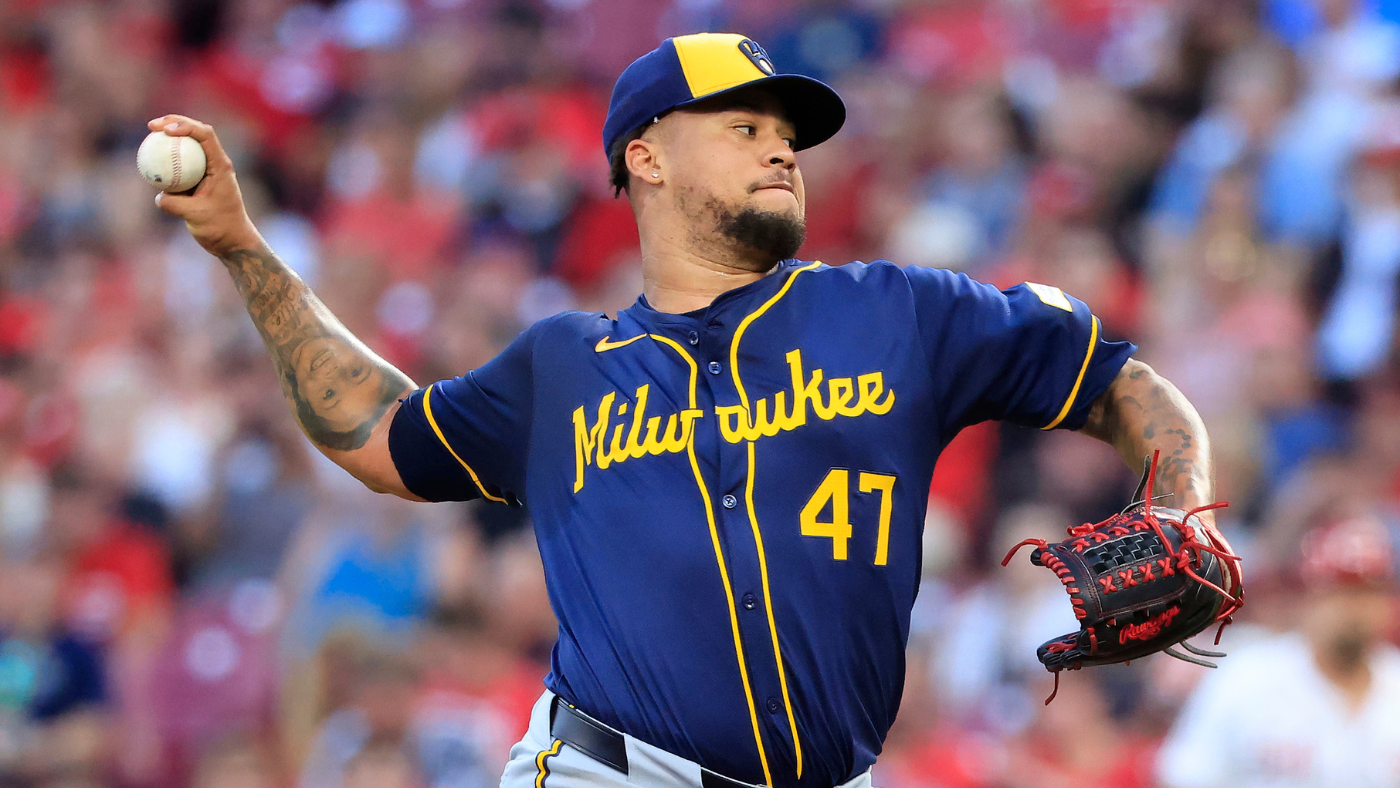
The New York Mets made an addition to their rotation on Sunday, . The 31-year-old Montas has had a mixed season Cincinnati Reds And Milwaukee Brewers He posted an ERA of 4.84 (89 ERA+) and a strikeout-to-walk ratio of 2.24 in 30 starts.
These grades, especially the ERA, are slightly below average for a starting pitcher. we found that “the ingredients are there for better numbers.” The Mets seem to agree.
It just so happens that the Mets have done this song and dance before, and done it quite well. Last winter, top baseball executive David Stearns signed Sean Manaea And Luis Severino to similar short-term pacts. Both Manaea and Severino continued to have good seasons and were able to land more lucrative free agent contracts this offseason. (The Mets could also lose Jose Quintana hit the open market, leaving them without their top three innings earners from the 2024 season.)
Why are we (and apparently the Mets) optimistic about Montas? We have outlined three reasons below.
1. Superior track record
While we believe the Mets are looking forward, not backward, in signing Montas, we would be remiss if we didn't note that he has proven throughout his career that he is a capable big league starter – after all, he's just a few years removed from finishing sixth in Cy Young Award voting. Additionally, Montas has made more than ten starts in a season six times and was average or better in four of those seasons.
If the perception of Montas feels worse than reality, it's probably due to a few factors. First, he's coming off a bad season in which he hit an uncharacteristic number of home runs – so much so that we have to assume he will experience a positive regression in 2025. There's also the bad vibes that come from Montas' disappointing outing on the season New York Yankees. You may recall that he made eight poor starts with them in 2022 before missing most of the year in 2023.
Still, there is reason for optimism in Montas' game.
2. Better stuff than results
Montas will turn 32 before Opening Day, making it somewhat absurd to focus on his supposed upside. That's just how it is with pitchers, especially these days. To some extent, advances in technology and data have made it easier for pitchers to achieve quick and significant success.
Montas already has a good foundation. Last season, he threw five pitches more than 10% of the time, in the form of two mid-90s fastballs, a cutter, a splitter and a slider. It's fair to write that he has several above-average offers, but you don't have to take our word for it.
Rather, we live in a time in which there are numerous publicly available pitch quality models for consulting. These models take into account the inherent properties of a pitch (its speed and motion profile) and output a number. You don't have to worry about the calculations to keep track. And the point is that Montas has several above-average pitches, according to the data stored at FanGraphs And Baseball Prospectus: his slider, his splitter and his sweeper.
See for yourself, but note that Stuff+ works on a scale with a base of 100, and the more negative a StuffPro number is for a given pitch, the better.
|
stuff+ |
83 |
83 |
109 |
119 |
N/A |
117 |
|
StuffPro |
0.4 |
0.6 |
0.4 |
-0.8 |
-1.3 |
-0.7 |
Obviously the ingredients are there. So the key for the Mets is to optimize Montas' pitch mix. And hey, would you look at this? It's a fitting transition to the next section.
3. End of season improvements
After a midseason move to the Brewers, Montas has already begun to fine-tune the way he uses his arsenal. Although his ERA didn't make much progress (he owned an ERA+ of 92, as opposed to 88 with the Reds), some of his underlying metrics suggested he was significantly better with Milwaukee.
In fact, Montas's strikeout-minus-walk rate rose to over 18%, a figure that would have ranked in the top 20 in the majors had he managed it over a full season.
What did the Brewers have Montas do differently? A few things, as far as we can tell. He increased the use of countersinking and cutting knives while reducing the role of his sliders and splitters. This seems contrary to what the pitch models would recommend, but that's the beauty (or pain, depending on your point of view) of such information: it's not necessarily a perfect representation of reality.
|
Redness |
33.8% |
16.4% |
17.2% |
11.4% |
21.2% |
|
brewer |
33.2% |
23.5% |
21% |
9.5% |
13.8% |
It remains to be seen whether the Mets ask Montas to double down on these changes or instead task him with making other tweaks that better fit the pitch quality models. For now, however, the future is wide open and Montas appears to be a worthwhile move for a team that has been there and done it before.