Inspired by what’s been one of the more exciting FIFA Men’s World Cups in the tournament’s near-century-long history, ESPN’s Bill Barnwell wrote about a hypothetical “Domestic Cup of American Football” last week.
Using a set of guidelines to determine rosters, Barnwell split the United States into eight regions to see which one had the best collection of active NFL talent.
Feeling dually inspired by the World Cup and Barnwell’s article, we made the “Domestic Cup of Ravens Football” to see which region of the U.S. has produced the best Ravens. Unfortunately, not every region of the U.S. is represented (such as the Pacific Northwest) because there aren’t enough Ravens from there.
Eligibility is determined by where each Raven played high school football. Newcomers are eligible, and this is based on players’ peak time with the Ravens (not the rest of their career).
Dilfer only played eight of his 130 career games with Baltimore, but that’s enough to dub him the Golden State’s QB1. Besides, he went 7-1 with the Ravens, including a Super Bowl XXXV title. Tony Banks was also considered as the backup quarterback.
California, which is paper-thin at running backs who’ve played for the Ravens, would’ve loved to have the version of Williams who was a star with the New Orleans Saints and Miami Dolphins. Instead, 2011 Ricky Williams tallied 444 rushing yards on 108 carries as Ray Rice’s backup.
Smith Sr. and Pitta are a stellar wide receiver-tight end duo, and California takes advantage of the extra slot for a skill position player by adding Dickson, who played high school football in Bellflower, California.
While Mekari and Mulitalo make for a strong guard tandem, California will have trouble blocking premier edge rushers.
Rushing the passer is going to a struggle for California, especially considering the offensive lines they might face in this tournament.
While getting after the quarterback would be an issue for California, its secondary is elite. California has two Pro Bowlers at outside cornerback in McAlister and Peters along with Smith, a starting cornerback for much of the 2010s who helped them win Super Bowl XLVII with a goal-line stand. Backing them up at safety are a multi-time Pro Bowler (Weddle), a key cog in what was a stellar New England Patriots defense last season (Hawkins), and a positive contributor to Baltimore’s secondary in the 2000s (Demps).
California is the only team in this exercise who never produced a Ravens kicker or punter. Boller, the former Ravens quarterback who had one career punt in Baltimore, has to fill in.
Only four quarterbacks have thrown at least 1,000 passes for the Ravens, and the Northeast lucks out by getting two of them in Flacco and Testaverde, who’ll step in should something happen to Flacco. Plus, the Northeast won’t have to rely heavily on the aerial attack for offensive production.
Only five players have run for at least 3,000 yards with the Ravens, and the Northeast got two of them in Rice and Gus Edwards. This is one of the best running back rooms in the tournament.
While Ismael and Likely are nice additions, the Northeast doesn’t have much depth at pass catcher, which is a shame considering that they have both Flacco and Testaverde available at quarterback.
The Northeast is thankful that Eluemenor moved from England to New Jersey with his father when he was 14. Otherwise, this region wouldn’t look as good at offensive tackle. Urschel, Gradkowski and Flynn are also underrated and versatile additions on the interior.
With Siragusa, a franchise legend, and Travis Jones, a rising star, being flanked by Burnett and Weaver on the outside, the Northeast has a rock-solid defensive line. This group could have some fun sack celebrations.
This is one of the more underrated tandems of any position group. McClain was a starter on the 2012 Super Bowl team. Adding Oweh to the aforementioned defensive line creates one of the better pass rush groups in the tournament.
The Northeast’s secondary doesn’t jump off the screen like some other units in the tournament, but the unit is far from the weakest. Graham starred in the “Mile High Miracle” with two interceptions, including one in overtime that set up Justin Tucker’s game-winning kick. He was an unheralded key piece of that Super Bowl team. Stone had his best seasons yet in Baltimore.
Neither Wright nor West played in Baltimore for very long, as they combined for about four-and-a-half seasons with the Ravens. But the South Atlantic lacked high-end options at both of these positions, especially at quarterback, where the only other option was Trace McSorley. Taylor has had an impressive 15-year career thus far, but he didn’t start a game in his four seasons as Flacco’s backup in Baltimore.
Maryland and Virginia do a lot of the heavy lifting in the pass catcher room, as Hopkins, a South Carolina native, is the only one not from one of those two states. Smith has the fourth-most receiving yards in franchise history and scores double points for playing high school ball in Virginia and college ball at the University of Maryland. Elijah Sarratt and Michael Campanaro were also considered here.
The offensive line might be the South Atlantic’s biggest strength with Ogden and Moses at the tackle spots. The quarterbacks and skill position players aren’t as formidable as most other regions, but at the very least, quarterbacks will have time to throw, and running backs will have open running lanes to hit.
While Canty, Webster and Clowney must kick inside due to the lack of depth at defensive tackle, the South Atlantic has a solid threesome of edge rushers that includes a multi-time Pro Bowler in McCrary.
This is a phenomenal tandem. Boulware also provides positional flexibility, as he can rush at the line of scrimmage as well.
Good luck trying to stop this unit. There is a stunning amount of star power on Florida’s offense, and the gap between them and everyone else might be wider than the Sunshine State itself.
With Jackson, Henry and Flowers, Florida has what could be the Ravens’ best quarterback, running back and wide receiver in franchise history when each of their careers are over.
Source: www.baltimoreravens.com
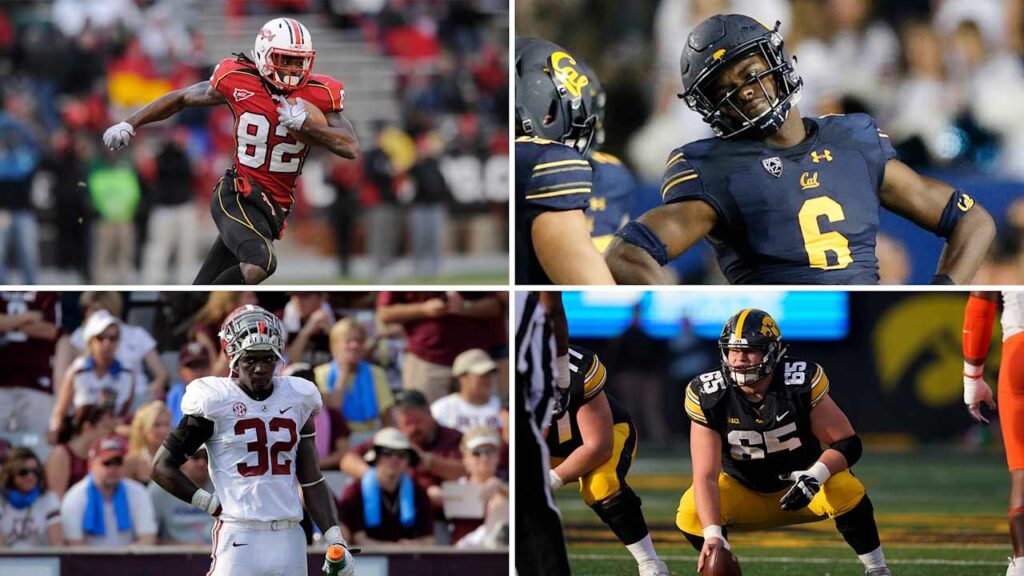
 Nick Wass (top left), Rick Bowmer (top right), David J. Phillip (bottom left), Charlie Neibergall (bottom right)/AP Photo
Former WR Torrey Smith (top left), S Jaylinn Hawkins (top right), former LB C.J. Mosley (bottom left) and former C Tyler Linderbaum (bottom right)
Nick Wass (top left), Rick Bowmer (top right), David J. Phillip (bottom left), Charlie Neibergall (bottom right)/AP Photo
Former WR Torrey Smith (top left), S Jaylinn Hawkins (top right), former LB C.J. Mosley (bottom left) and former C Tyler Linderbaum (bottom right)