
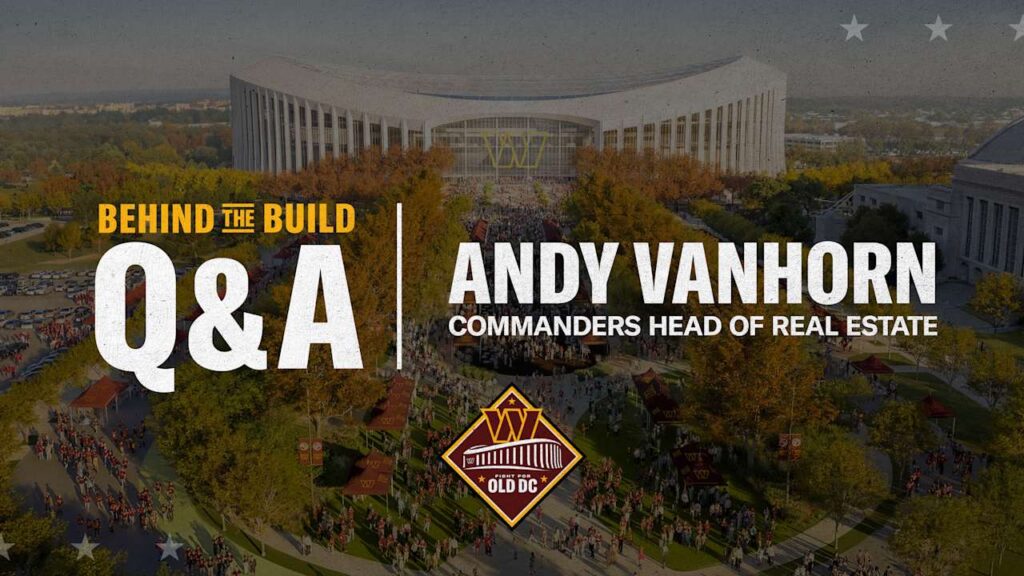
With eyes on Washington’s new stadium opening in 2030, *Commanders.com* is sitting down with key actors and decision-makers involved in the historic project. Andy VanHorn, the Commanders’ Head of Real Estate, brings over 20 years of experience to this critical, first-of-its-kind role with the franchise.
Before joining the Commanders last year, VanHorn was the Chief Executive Officer of Dweck Properties, leading operations for their 7,200-plus unit portfolio in the Washington, D.C. metro area. Prior to Dweck, he was an Executive Vice President and Principal with JBG SMITH for over 15 years where he was responsible for entitlement, community and governmental activities associated with JBG SMITH’s portfolio in National Landing, including Amazon’s HQ and the associated infrastructure improvements.
As the Commanders’ Head of Real Estate, VanHorn works closely with land seller(s), government entities and local officials, and is responsible for the design, construction and completion of the real estate elements associated with the new stadium as well as other team projects and properties in the region.
A: “When I was a kid, I was always interested in building stuff. Whether it was doing a community project with Eagles Scouts or playing with marble chutes or later, building a firehouse, I realized I really liked how things come together and the complexity and the process of assembling things.
I came out of Lehigh University with an engineering degree, which gave me a strong base of skills to support the construction world. A stint at Clark Construction helped me realize that I wanted to step back more and direct the building of projects.
After working for a large developer, I went back to get my business degree at Georgetown, because I realized I needed to learn finance and accounting and other skills to drive this part of my career.”
Q: After 25 years in the industry, what about this role with the Commanders stood out to you as your next professional challenge?
A: “I’ve worked on a variety of projects in my career — built buildings right at the entrance of Nationals Park; built two really large projects in the heart of Rosslyn; and helped redevelop that whole kind of Arlington market. Then, I was able to lead the entire strategy of bringing Amazon to the region and help redevelop and reinvigorate National Landing. From my perspective I was thinking, ‘Oh, I won’t do anything bigger,’ and then this job came calling.
Having the ability to impact not only where the franchise is located but thinking about how you bring something back to RFK was intriguing. And then we have the six or seven million square feet of development around it that we control which is truly region-changing. The opportunity to be part of that was incredibly exciting. I really find meaning in improving our communities and delivering something for folks who live there, and this was the ability to do all of that times 10.”
Q: Turning to the historic new stadium project, some initial renderings of the team’s future home in D.C. have been unveiled. What felt most important to convey to fans with these first looks?
A: “We wanted to show that we heard them. We knew their love for this site and for the old stadium that was there. We felt that. The renderings we’ve shown have the heritage of RFK in them. They locate the stadium in the exact same spot, but they also added that D.C. monumentality. I think the combination of knowing you’re in DC and knowing that this is what the stadium looked like before is pretty incredible for our fan base.”
Q: There are a couple different new stadium projects in the works around the league. Unique to this one is that the stadium will be built on the site of the team’s former home, RFK Stadium, a venue that held so much history and meaning to fans and the city. What has been your approach to balancing old and new with this project?
A: “I think the one thing that does differentiate our stadium is it really isn’t going to be what people picture as a new stadium today. It’s a bit of a throwback in many ways. There’s going to be a lot of really powerful colonnades, some concrete, but it’s also going to be incredibly accessible, like our monuments. There will be openings in the façade. You’ll be able to walk up to it. You’ll have landscaping all around it.
It won’t have a modern hard edge. It will be very much this integrated facility into the neighborhood and into D.C., and I think that is something very different that hasn’t happened for decades. But that is something that throws back all the way to Roman times when you think about how the Coliseum and other features were built. They were part of the community, and they were part of the mixed use and built environment. And so, bringing it back into RFK and then adding the neighborhood around it is really unique for a stadium being built today.”
