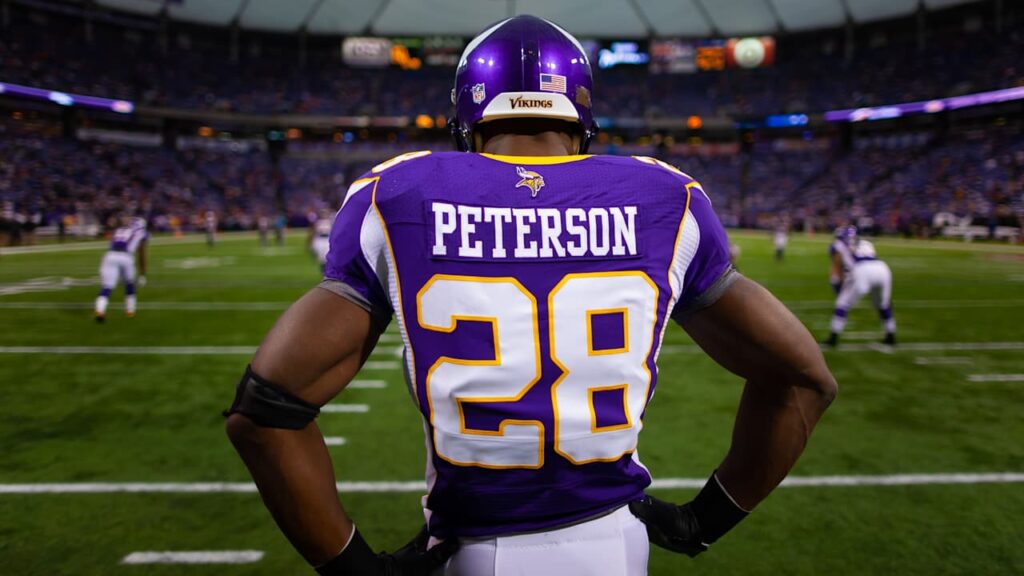
In an article by PFF’s Nathan Jahnke at the end of last month, Adrian Peterson and Harrison Smith made the cut. The former was recognized as a Second-Team running back, the latter a First-Team safety.
We’re fighting the urge to state Peterson’s case as RB1 over Derrick Henry, who has been awesome, producing five efforts of 1,500-plus rushing yards in the past seven seasons, but even at the top of his game (2020) didn’t hit the heights Peterson reached as the last back to win the NFL MVP Award in 2012.
The methodology used by PFF, however, delicately balanced peak performance with longevity — looking only at a player’s five best seasons with a franchise from 2006-25 — and Jahnke pointed out Henry edged Peterson in several pertinent categories across their respective summits, including more yards after contact per carry (3.6 to 3.0), higher avoided tackle and first down rates, and significantly fewer fumbles.
Nevertheless, Peterson’s heyday was special enough to deny a bundle of other backs: from No. 3 all-time rusher Frank Gore and draft classmate Marshawn Lynch, aka “Beast Mode,” to electric two-phase players such as Christian McCaffrey and Jamaal Charles, and past and present bell cows Ezekiel Elliott and Saquon Barkley, to name a few. There are just two Hall of Fame running backs from the PFF era, by the way — Edgerrin James and LaDainian Tomlinson — and most of their “top” seasons were before 2006.
Peterson is a good bet to become the third enshrined in his first year of eligibility in 2027.
Moving along, Jahnke admitted the safety position is maybe “the most controversial” because it omits Gold Jackets Troy Polamalu and Ed Reed. Jahnke noted the famed rivals would’ve made the third team. They played plenty of legendary football post-2006, but PFF felt more strongly about Smith and Eric Weddle as the First-Team safeties and Devin McCourty and Kerry Rhodes, models of consistency, on the second team. (Also, keep in mind that Reed’s Defensive Player of the Year campaign happened in 2004.)
Weddle, Smith and McCourty are three of the five safeties with over 12,000 snaps during the PFF era and three of the five with grades above 90.0. All three own grades above 92.0 in both run defense and coverage. Pass-rushing helped differentiate the three, as Weddle and Smith blitzed much more than McCourty and were more successful on a per-play basis.
Rhodes was elevated by his 2007 season, where his 93.1 PFF run-defense grade was the best for any safety in a season. While Polamalu, Reed and Brian Dawkins won all the safety awards in the late 2000s, Rhodes was the highest-graded safety from 2006-08, with Polamalu in second and Reed in third.
Smith leads active players in interceptions (39) and yards gained on INT runbacks (510) and is undecided on if he will retire or return for his 15th season, so don’t write off him improving those numbers just yet.
Click here to find out the full 24-man rosters, comprised of 12 offensive and defensive players (48 total).
What do Hassan Jones, David Dixon, Henry Thomas, Brian Robison and E.J. Henderson have in common?
Well, they are Vikings Legends — and the first five entries in Part 1 of Purple Insider’s countdown of the most underrated Vikings of the past half-century, a stretch that coincides with the club’s most recent Super Bowl appearance. To remember those five decades — full of woes and glows and players who were integral to success but perhaps forgotten about relative to their superstar counterparts — Matthew Coller and Josh Smith launched a series that will highlight 20 Vikings who fit the “underrated” box in some way.
The criteria are expansive. In some instances, Coller and Smith are electing players who were admired by Vikings fans but didn’t receive much national attention. In other cases, subtler contributions are praised.
Jones (No. 20), Dixon (19), Thomas (18), Robison (17) and Henderson (16) make up the first installment.
You can read the entire piece here, and we will share an excerpt about Thomas written by Coller, below:
Consistency is always going to go underrated, but Thomas’ style also didn’t get enough appreciation. His nickname was “Hardware Hank,” and he had a cockeyed stance that you could spot from the highest seats in the Metrodome.
With a player like Thomas, the statistics that we have available now just don’t tell the entire story. He was undersized as a nose tackle, playing 30 or 40 pounds lighter than a lot of guys who lined up over the center, and he never came out of the game. Rotations were less used then, than now, but the ability to have such a talented player vs. the run and the pass on the field for every snap of the game is incredibly valuable.
The impact of having a top-notch DT who plays every snap can be seen in some of the broader team total stats, like in 1988 when the Vikings finished No. 2 in points allowed and No. 1 in yards allowed and gave up a 41.3 QB rating to opposing quarterbacks.
But Thomas largely flew under the radar because those clubs were so talented on the defensive line. Whether it was Chris Doleman or John Randle or Keith Millard’s legendary 1989 season with 18.0 sacks, Thomas’ steady hand never had the gaudy numbers that his cohorts put up. Still, he was every bit as valuable and is deserving of recognition.
View photos of Khyree Jackson’s family created a memorial locker called “Khyree’s Locker of Hope” filled with football gear for underserved youth.
Source: www.vikings.com