
For many amateur drivers, hopping between different GT3 cars would be viewed as a distraction. For FIA WEC LMGT3 driver Darren Leung, it’s become a deliberate training exercise and another prime example of the lengths to which Bronze-graded drivers in the current era will go to improve.
Over the past two seasons, Leung has sampled machinery from multiple manufacturers alongside his main WEC programmes with United Autosports and WRT, not because he’s searching for the perfect GT3 car, but because every new cockpit provides another opportunity to stress-test what he calls his “method.”
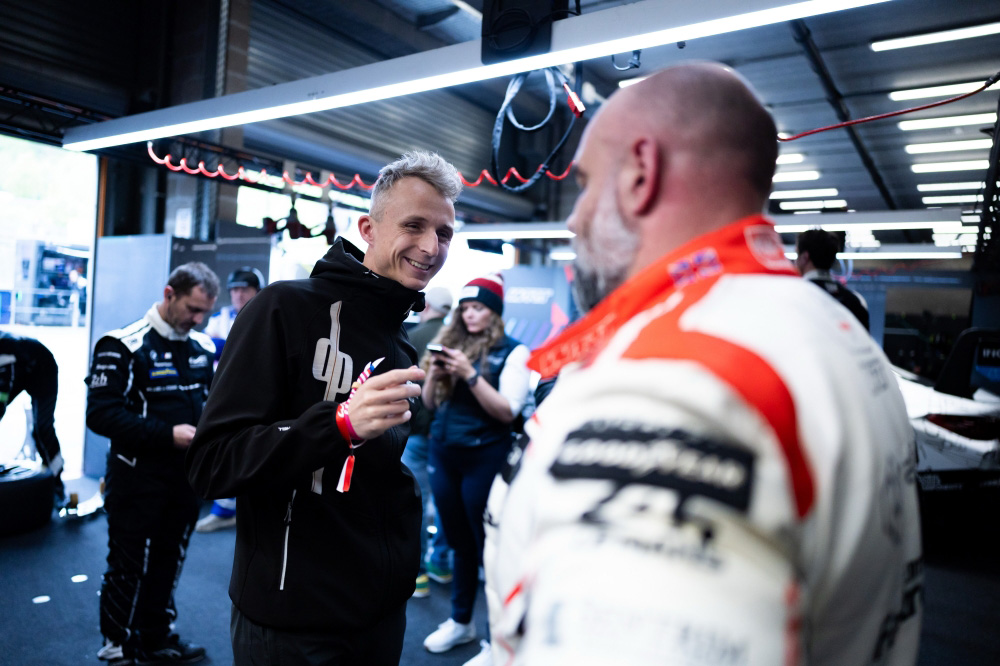
The approach began in 2023 after conversations with driver coach Andy Priaulx and performance specialists John Pratt and David Pittard (below), who encouraged him to think beyond simply driving faster.

“So I was working with Andy Priaulx and John Pratt, and John used to look after Andy back in the day, and one of the things that was spoken about a lot was that I needed to develop a method,” Leung explained.
“I was like, ‘What do you mean, like turning a bit slower, turn a bit faster?’ And he was like: ‘No, the whole working method is everything from understanding the car to understanding how the car does what it does, how you can change the setup to make it do different things and what’s happening with the track, grip and tyres.’”
That process quickly expanded far beyond setup knowledge.
The first step was understanding the technical characteristics of different GT3 cars — how weight distribution, wheelbase, aerodynamics and suspension philosophies influence performance. From there came the psychological side of performance, physical preparation and learning how to consistently extract pace regardless of circumstances.
“It was then also about developing a performance method as well,” he says. “So that was starting with mindset, and how you build performance psychologically. Because it’s a massive psychological game.

“One of the weirdest things in motorsport is that drivers get treated like analogue robots, who just repeat the same thing over and over again. It’s quite a unique sport in that it expects athletes to be able to practice only a few dozen times a year, and then repeat a performance. You learn through repetition, trial and error, it’s why kids go karting every week!”
Instead of relying on repetition in one car, Leung deliberately chose the opposite path.
“So, the thought was: What am I in it for? I’m in it to absolutely maximise every single year’s worth of results. That was the objective.
“By switching between teams and cars, what you’re doing is you’re essentially putting your method to the test, because when you come into a new car and a new team every week, you sort of run through your method in your head. Psychologically, you need pillars in place to be able to perform.”
That means approaching every new GT3 car as a fresh problem to solve.
Whether it’s the BMW M4 GT3, Ferrari 296 GT3, McLaren GT3 Evo or Lamborghini Huracán GT3 EVO2, Leung dives deep, breaking down how cars react through different corners, before determining how aggressively each one rewards — or punishes — particular driving techniques.

“The BMW really doesn’t want to be overdriven on an entry,” he explained. “The Ferrari, it’s like a total opposite, the Ferrari, you want to carry an ungodly amount of speed…
“So then what happens is you’ve got to break down each phase of each corner, and then you think, am I pushing the car here, or am I being precise with the car? It’s like two-thirds making sure you don’t drive it badly, versus one third trying to drive it well.”
The goal isn’t to discover which GT3 car suits him best.
“What suits you the best can change over time,” he said. “Tendencies can and do change through skill, repetition, approach, and all these sorts of things.”
Instead, the objective is to build a repeatable process that allows him to quickly understand any car placed underneath him. That philosophy has evolved year by year.
“The method was a big focus in 2023, but the method at that time was focused more on new tracks,” Leung said.
“In 2024, there was WEC, and there was GT World Challenge, and basically all tracks had never been driven, so the method was a lot to do with how you turn into a new circuit and get up to speed really quickly.
“But then halfway through that year, it felt like I turned into a new track, and I felt like one of my strengths now was getting up to speed quickly on a new track, so then the next challenge was like, well, can we get up some speed with new cars quickly as well?
“I’ve not driven the Ford, right? So I’d want someone to send me video and data, and I can look at someone doing the perfect Turn 1 at Spa, and I’d know it’s like the BMW because the car doesn’t like a rolling phase, so I need to make sure the braking point is accurate. It’s not about squeezing the last couple of metres of braking point. I’m going to make sure it’s accurate and that the bleed phase is precise, so I’m not overstressing the front.
“The key is I understand the characteristics. I’ll know if something is like the McLaren, or the Ferrari, where you can attack on entry, or the Lambo, where you’re rewarded by being on the edge with the rear.”

Behind the scenes, that has meant moving away from simply studying telemetry. Leung says he now spends less time looking at data than he once did because the focus has shifted towards understanding the car instinctively.
“Before, I relied on data because it was my background and strength. That’s tough. Now, if I’m out there and I only get five laps, 15 laps, before qualifying, then it doesn’t become as stressful, because I know if my method underlying my driving is solid, I know what I need to do.”
His coaches regularly create simulation exercises with unknown grip levels and setup changes, forcing him to diagnose handling problems and adapt within just a handful of laps.
“We’d focus on tracks and then focus on adapting to cars, but then the next thing we focused on was actually developing the internal feedback and analysis that I could do when I was in the car, so without looking at the data,” he explained.
“What we ended up doing was tons and tons of drills every week, where I would go out and they would alter on the sim the grip level of the tyres. I would have to adapt to a car that was totally different, and then understand what it was. You then test your intuition.”
“Then the goal is like what a lot of the pro drivers do: they get in, they feel what the car does, they know what to do with it, and then they can give feedback on where the weak points are of the car.”
Each race weekend ends with a review session, assessing not just driving but also preparation, mindset, and execution before the process begins again. It helps prevent him from overloading himself with data.
“Organisation really comes into it. It’s hard work to jump between cars. So, after an event, for example, I will have a Zoom call with at least David and John, probably with Andy as well, and then we have a bit of a holistic look at the full weekend,” Leung said.
“We look at everything from: how did I arrive at the track, what was the preparation like up to that point, what was the feeling like for me and in the team, did I manage to foster a good environment for myself to be able to perform in, and then what did the driving look like?”

The results suggest the method is working. Leung only started racing back in 2021, and in just a handful of years, he’s become one of the more high-profile Bronze drivers, winning races in each of his first two seasons in WEC LMGT3, a GT World Challenge Europe Bronze Cup Sprint title, and a British GT title in 2023. He also finished second in class at Le Mans in 2024 during his first season on the world stage and was the fastest Bronze-graded driver on stint average at this year’s Spa 24 Hours.
Leung also cites his LMGT3 pole position at the 2025 season opener in Qatar, as validation.
“I think, to be honest, I’m pretty happy,” he said. “I’m pretty happy with having developed my method and having it built together with some guys who really know what they’re doing, and then I’ve stress tested it in multiple environments.
“For example, last year in WEC, I managed to put it on pole in the first race, which was really a good indicator for me that clearly the method was working reasonably well.”
As you’d expect, Leung heads into Interlagos well prepared, but not just because of his method. In a bid to ensure he arrives in São Paulo ready for action, he took part in a Brazilian Endurance Series race at the same circuit earlier this year with his WRT teammate Augusto Farfus in an LMGT3-spec M4 GT3 and won his class. Another example of Leung’s desire to take the next step.
Images courtesy of BMW, Andrew Hall, David Lord & Andrew Lofthouse
The post Darren Leung & His Method To “Maximise Every Result” first appeared on dailysportscar.com.
Source: www.dailysportscar.com