
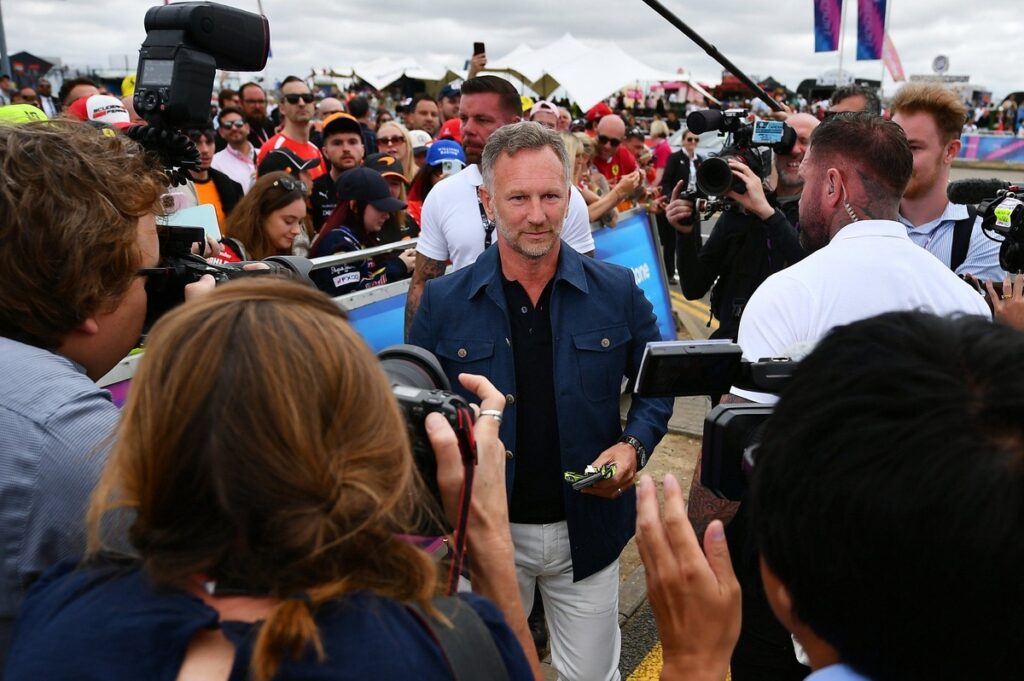
A year ago to the day Christian Horner was axed as Red Bull boss. Is the Formula 1 team in a better or worse shape now?
Growing pains under new management should pay off – Jake Boxall-Legge
On this day one year ago, Christian Horner was sacked as Red Bull Formula 1 team principal after 20 years in charge.
Since then Laurent Mekies was installed as the new team boss, the team enjoyed a resurgence in 2025 in which Max Verstappen came two points off taking a fifth world title and the team began its new era with Red Bull Ford Powertrains.
There’s been bumps along the way, from Yuki Tsunoda’s demotion and Isack Hadjar installed in the tricky second seat alongside Verstappen, to losing key personnel to rival squads, to an unhappy Verstappen who is pondering his future both at the team and in F1.
So, is Red Bull better or worse off than where it was 12 months ago? Our writers have their say.
When there’s a change in management at a Formula 1 team, a new team principal often wants to change the way that a team operates. Since Red Bull spent 20 years under Christian Horner’s aegis, his style of leadership and his expectation of the team’s working practices have been deeply ingrained throughout the Milton Keynes factory’s halls for some time. It takes a long time to change those habits.
On Horner’s dismissal, later supplanted by Laurent Mekies, it was unsurprising that Mekies wanted to take a different approach. Perhaps an F1 car is the best allegory for this; it might be designed to function in a certain way, based upon a previous driver’s feedback to get the best out of their attributes and skillset. Put another driver in it, with a vastly different driving style, and they might struggle to operate at the car’s peak.
Over 20 years, Red Bull has been designed to function under a certain brand of leadership; when the team is asked to operate with a different approach, it exposes flaws and redundancies in the system. That’s no bad thing, and nor is it a bad thing that some of Red Bull’s biggest players have trickled out of the exit door over the past year. A team cannot realistically expect to keep its key staff forever. Red Bull is undergoing a painful metamorphosis, sure, but it’s one that needed to happen at some point down the line. Pain now, or pain tomorrow? That’s the choice, and Red Bull chose to take the hit in the present.
Red Bull had existed in a largely similar state for years; when that produced a winning car, it was great, but the slide in performance through 2024 and 2025 actually accentuated flaws, those that could be exposed when McLaren – which had been through the same issues itself over the 2010s – finally got the ingredients right at Woking. Winning demonstrates what a team gets right; losing demonstrates what it gets wrong.
And here’s the situation: Red Bull’s old wind tunnel was no longer fit for purpose, the team relied too much on certain members of staff, and continues to rely on Max Verstappen to overcome the deficiencies in machinery. It’s had to wean itself off many of the aspects that covered up its weaknesses.
So, is Red Bull better off without Horner? Long-term, it probably is. Had it kept its former overlord, the team will have continued to function in much the same way as it had over the previous two decades, and perhaps remained comfortable enough to overlook the flaws. In following Mekies’ vision, the team has to take a new approach. It might be uncomfortable, and it might come with a drop in performance as the team players adjust to their new environment, but it’s all in the name of future-proofing.
It might not feel like Red Bull is going anywhere at the moment, given that the folk who follow F1 demand instant success. But the F1 teams which lasted have undergone myriad rebuilds, and it’s now Red Bull’s time to have a turn with the patching trowel.
It’s like this: if a bird defecates on your windscreen and you don’t care enough to clean it, your brain eventually wires itself to ignore the mark. It takes someone else to point out that there is, indeed, a bird poo on your car…
Looking at the current situation, the challenges Red Bull face are greater than they were a year ago. Max Verstappen was also unhappy with the car’s performance back then, but the team still managed to produce a remarkable turnaround. This year, however, such a recovery appears highly unlikely, something Verstappen himself also acknowledged at Silverstone.
On the chassis side, there is only so much the team can do after the major upgrade packages in Miami and Spielberg, while on the power unit side Red Bull appears to be lacking on the electrical front. Mekies openly admitted on Sunday that Red Bull struggles at energy-starved circuits, meaning that after Silverstone, Spa and Monza could prove equally challenging.
There is no short-term solution, as Red Bull currently tops the FIA’s internal combustion engine ranking. That means the manufacturer is not eligible for an ADUO token and is therefore unable to modify the hardware of its power unit. Taken together, those factors make it extremely difficult for Red Bull to turn its season around in the way it managed to do last year.
Those issues are not something that can be blamed on Mekies, though. Last year’s political turmoil meant something had to change, with Christian Horner ultimately having to step aside if Red Bull wanted to retain the Verstappens. Given that leadership change and the political reality at the time – with Verstappen speaking positively about Mekies – it was logical for him to stay for 2026, even if that decision has made his position on the driver market more complicated.
Mekies arrived with a refreshing approach and was widely praised for implementing his engineering background, resulting in largely positive feedback from within the team during his first months in charge. Life in F1, however, comes with peaks and troughs – even for the most successful team principals in the paddock – and this is probably the first crisis Mekies has had to deal with at Red Bull.
The performance is falling short, quick solutions do not appear to be available, and then there is Verstappen’s frustration, which he has not hidden in public. Verstappen has always been straightforward with the media – something the international press appreciates about him – and in Canada and Austria he openly stated that the team had not listened to him. That is notable given that Mekies has repeatedly described Verstappen as “the most important sensor” in the car.
While the disappointing performance in 2026 and the limited opportunities to turn things around quickly should not be held against Mekies, it will be fascinating to see how Red Bull’s new leadership handles the current situation. In many respects, this seems the most challenging period the Milton Keynes-based team has faced since the Frenchman took over 12 months ago.
It depends on who you ask, but for all the technically oriented solutions Laurent Mekies has brought to the team, there are also those who will miss Horner’s influence. Mekies was credited for bringing a free mindset to the team, an engineering-led approach that found solutions to some of Red Bull’s biggest 2025 car problems. It also restored some sense of calm after a turbulent power struggle that split the leadership team in camps.
At the same time, Horner did bring strong leadership to the table, and his free rein to run Milton Keynes as he pleased, which ended up contributing his downfall, also shielded the team from scrutiny from Red Bull Austria. I have yet to be convinced that his replacement Mekies is afforded the same leeway, and that hard-nosed Red Bull CEO Oliver Mintzlaff is letting the team get on with things the same way Red Bull did before.
A disappointing start to 2026, coinciding with the same old rumours around Max Verstappen’s future, certainly isn’t easing the pressure on Red Bull’s leadership team.
There has been a narrative of a brain drain created around the team, with many key names either leaving the team or on their way out. The team has disputed this, boasting its tremendous strength in depth. It is true that Red Bull’s F1 team is employing over a thousand people in Milton Keynes, and that the leaders leaving the team like Gianpiero Lambiase and Paul Monaghan are a handful of high-profile names that the media and public happen to know about while their undoubtedly talented replacements, if coming from within, are not.
But even if the team is right in saying it has the strength in depth, and that it keeps receiving plenty of high-calibre CVs of talent wanting to work for the squad, perhaps there is at least a perception issue there. Pulling off a few coups on the transfer market would help with that.
Red Bull’s biggest plus has been the performance of its first in-house power unit, at least the internal combustion engine, which has been deemed the most powerful of the field. That has had significant implications with the ADUO upgrade scheme, which Red Bull now appears to be frozen out of. Has the FIA made a mistake there? Or has Red Bull been found out by not playing the political game well enough compared to the likes of Mercedes and especially Ferrari? If you ask around in the F1 paddock, both opinions are available. If the latter is true, it would be a harsh lesson to learn for Horner’s successor.
Source: www.autosport.com