
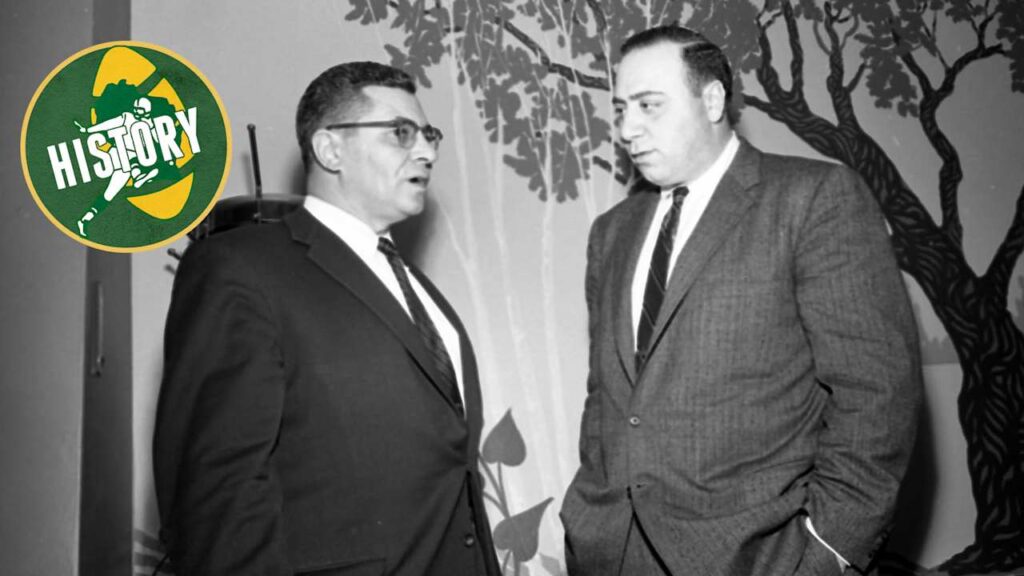
The 1959 Packers spent 64 of 143 days on the road

Why did Vince Lombardi announce after being hired by the Packers that Jack Vainisi would spend more of his time in a capacity similar to a traveling secretary in baseball after promoting him to business manager?
Based on my research, Lombardi never publicly offered any insight on that decision, so all I can do is offer an educated guess. I’d prefer not to do that, but there’s only one explanation in this case that makes sense to me.
First some background. Upon Lombardi’s arrival in Green Bay on Feb. 2, 1959, five days after he accepted the dual positions of coach and general manager, he announced that he was retaining Vainisi in his current capacity as a talent scout.
Lombardi said his next hires would be four assistant coaches and a business manager. Lombardi completed his coaching staff within three weeks. It took almost two months before he announced that Vainisi would serve as business manager.
When he did, on March 19, Lombardi said Vainisi would continue to work on player personnel but also take on new duties similar to those of a traveling secretary in baseball.
Traveling secretaries in baseball arrange for flights, buses, hotel stays and meals or meal money, among other duties, for their team’s road trips. It’s a demanding, high-pressure position partly because of their reliance on countless others to be on time and avoid screwups.
In baseball, they arrange the itineraries for traveling parties of 30 or more people. In pro football, back then, it might have been closer to 50 or more and likely included the following responsibilities: Arranging all chartered and occasionally commercial transportation, renting trucks to haul equipment, scheduling use of practice fields and locker rooms, booking entire floors of hotel rooms and private meeting rooms, and handling meal options.
And at all times, the expectation of the head coach would have been zero disruptions and distractions.

Considering Lombardi’s first hire was Vainisi, the one obvious assumption to be drawn is that he held him in the highest regard and wasn’t assigning those duties to him just to add busy work to his plate.
Keep in mind that when Lombardi was hired the Packers’ offices were located on S. Washington St. in downtown Green Bay. They would not be moved to what is now Lambeau Field until almost three years after Vainisi’s death in November 1960.
As for the rest of the staff in 1959, besides Lombardi and his four assistants, it was limited to Vainisi, former general manager Verne Lewellen, who had been reassigned to the role of administrative assistant, Tom Miller as publicity director, Earl Falck as ticket director and less than a handful of secretaries.
With such a limited staff, Lombardi had few other options other than Vainisi to oversee travel. Lewellen was put in charge of special assignments, including handling radio and TV contracts, and doing some scouting for Vainisi.
During the 1950s, it wasn’t unusual for other NFL teams to rely only on a part-time scout or what today is called a director of player personnel to prepare for the draft. In Vainisi’s case, he was hired in 1950 to compile statistics and keep records on college players. Pre-Lombardi, he also handled other office duties, including a brief stint as temporary publicity director in 1956.
So for Vainisi to have other responsibilities besides the draft wouldn’t have been unusual at the time.
In 1959, the Packers’ season, starting with the first official day of training camp and ending with their return home from their final regular-season game, covered 143 days. In all, they spent 64 of them in other cities or traveling to and from Green Bay.
In other words, 45 percent of their days were spent on the road. It included 21 consecutive days in five cities at the end of training camp, and a 15-day stay on the West Coast at the end of the regular season.
In addition to their away games in other NFL cities, the Packers spent time in Portland, Ore.; Bangor, Maine; Greensboro and Winston-Salem, N.C.; Pewaukee, Wis.; and Santa Monica and Palo Alto, Calif.
Taking into account Lombardi’s volatile temper and hair-trigger impatience; fixation with punctuality; plan to go first class after years of the Packers traveling on the cheap; and a desire to hold light workouts on Saturdays in the stadiums where they’d be playing the next day; to me, it stands to reason that he’d want his most trusted confidant to handle all travel details, even if it meant having Vainisi spend fewer hours preparing for the draft.
Besides, as Vainisi explained in a Nov. 26, 1959, Green Bay Press-Gazette story, Lombardi had completely reorganized the Packers’ scouting efforts.
In essence, the Packers relied more on their in-house evaluations than scouting reports from a network of mostly college coaches and alums as they had done when Curly Lambeau was in charge of the draft from 1936-50, and during the reigns of Gene Ronzani, Lisle Blackbourn and Scooter McLean from the 1951-59 drafts.
“It’s something new and not like anything before,” said Vainisi. “The draft under coach Lombardi is a complete 100 percent staff effort.”
Vainisi said each prospect was graded by Lombardi, his four assistants, Lewellen and he himself. He noted the assistant coaches and Lewellen had made a number of scouting trips during the season, while he and Lewellen still relied on reports from the Packers’ paid “bird dogs” as a basis for their evaluations.
Lombardi’s assistants did much of their scouting on Saturdays during the season. They’d scout a college game and then fly to wherever the Packers were playing on that Sunday after their game ended. In the spring of 1960, Lombardi also assigned his four assistant coaches territories across the country to scout spring practices and send their reports back to Vainisi and Lewellen, who together coordinated the process.
“We each make our own rating on each athlete and from this rating we are able to figure the draft value of each prospect,” Vainisi explained. “It’s almost like a vote and no one man (referencing the previous head coaches), as in the past, makes a complete decision on a prospect’s value.”
Under Lombardi’s system, the assistant coaches did far more scouting than in the past. “We’ll be covering in person or by special scout more than 300 college practices,” Vainisi told the Press-Gazette in February 1960.
Source: www.packers.com